

AI sales agents are software that does part of the selling work: researching accounts, writing messages, following up, handling replies and booking meetings. A person sets the goal and stays responsible for what goes out. They fit best where the work is repetitive and the volume is more than a team can cover by hand.
This guide explains what AI sales agents do, where they fit and how to start without changing how your team already works. It is written for agency owners and small sales teams.
What are AI sales agents, and what can they do?
An AI sales agent is a program that does a defined job in the sales process and chooses its next step from the data in front of it. Traditional sales automation follows fixed rules, such as sending the second email after a set number of days. An agent first reads the situation, such as a reply or a change at a company, and then acts. Some combine fixed rules with machine learning models that read buyer signals.
An agent can take on any of these jobs:
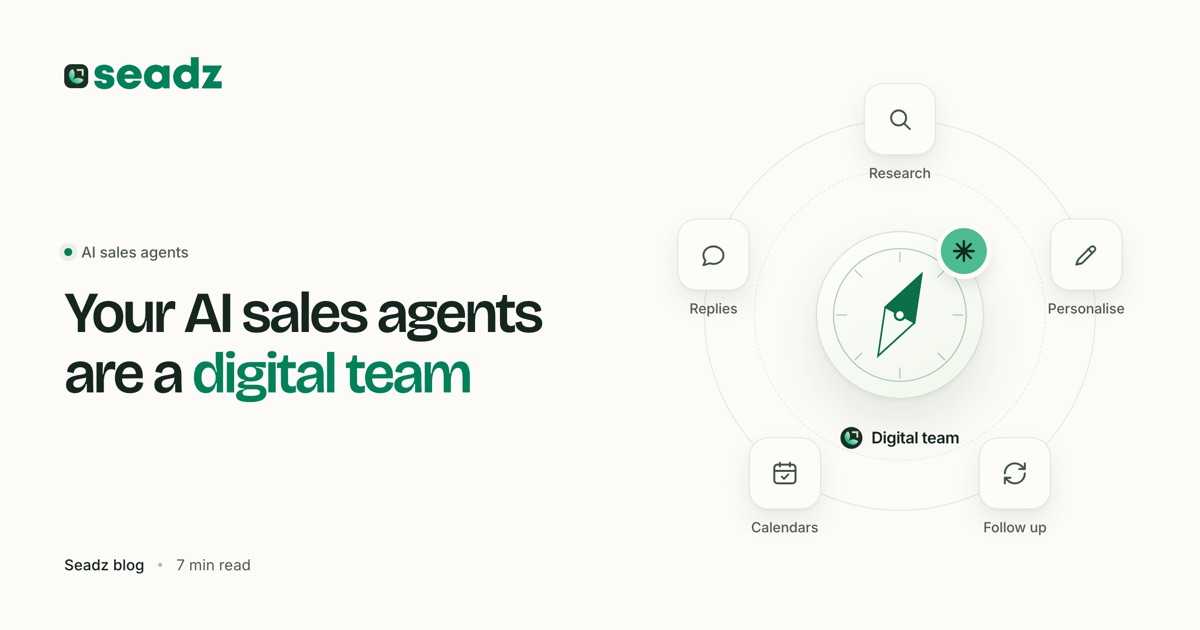
- Research reads what a company publishes, such as its site, ads and job posts, to find a reason to write.
- Lead scoring and qualification rank accounts by fit and by signs of interest.
- Personalisation writes emails and LinkedIn messages from what is known about the company and the person.
- Follow-up sends the next message on time and stops when someone replies.
- Reply handling separates interest from objections and opt-outs.
- Scheduling proposes times and books the meeting.
- Conversation answers inbound questions through chat or voice.
All of this depends on clean data and a clear objective. Someone on your team should own what goes out. To see one job from start to finish, open the Outreach OS demo.
Why AI sales agents matter for a small team
A lead that waits for an answer cools down, and a follow-up nobody sends is a conversation that does not take place. A small team cannot research every account that fits and also take the calls. Agents take research, first drafts and follow-up off the team's plate, so more of that work happens on time.
Timing can matter too. A growth hire or a funding round is a reason to write now, not later, and an agent can watch for such changes continuously.
Key benefits of AI sales agents
Results vary by market, offer and setup, so record a baseline before you start. Here is what agents can improve, and the metric that shows it:
- Replies and inbound requests can get an answer sooner. Track time to first response.
- Follow-up can run on schedule for each lead. Track the share of leads that get the full sequence.
- More accounts can be reached once research and first drafts stop capping the number. Track accounts contacted per week.
- CRM updates and scheduling can move to software. Track hours spent selling against hours on admin.
- Tagged messages and replies help you see which segment, message and timing get answers. Track reply rate and meetings booked per segment.
If the agent connects to your CRM and calendar, the data stays in one place. The return depends on setup and on tuning after launch, so judge the ROI against the baseline you recorded.
What to check before you start
Starting without preparation can waste budget and frustrate the team. Check four things first.
- Clean the records the agent will use, because duplicates, missing fields and outdated contacts produce wrong messages.
- Tell reps what the agent does, what it leaves alone and how to correct it, and involve them early.
- Cold email and personal data rules differ per country, so check the rules of every country you send to. Ask any vendor where contact data comes from and how opt-outs are handled.
- Someone should own what the agent sends. Read the first messages, review samples on a schedule and decide when a human takes over.
Run a pilot first: one segment, one channel, a fixed period and a success criterion written down in advance. Regular reviews can catch errors and bias before they spread.
How to implement AI sales agents, step by step
Skipping steps often leads to integration problems and low adoption. A practical sequence:
- Set one goal, such as more first meetings from a defined segment, and the number you compare against.
- Map the process from first touch to booked meeting and mark the repetitive steps. Those are the agent's jobs.
- If you use a CRM, clean the fields the agent will read and write.
- Choose the setup: software you run yourself, or a service that runs the agents for you.
- Run the pilot and read what goes out at the start.
- Compare with the baseline, fix what the replies show, then add segments or channels.
How long this takes depends on your data and your sales cycle, so set the length of the pilot before you start. For the prospecting side in detail, read our guide to AI outreach agents.
Tools and resources for AI sales agents
Options run from single-purpose tools to full platforms. The right choice depends on your needs, budget and technical skills. Categories to consider:
| Category | What it does | What to check |
|---|---|---|
| Sequencing software | Sends email and LinkedIn messages in steps | Whether a sequence pauses when someone replies or opts out |
| Data providers | Supply company and contact data | Where the data comes from, how fresh it is |
| CRM | Stores accounts, contacts and deals | Can the agent read and write your fields |
| Conversation tools | Answer inbound questions through chat or voice | What the agent may answer, when it hands over to a person |
| Calendar tools | Offer times and book meetings | Time zones, buffers, rescheduling |
| Call analysis | Records and summarises sales calls | Who can access the recordings, how long they are kept |
Ask for a demo or trial, test it on your own data and check security and integrations. Decide the strategy before you pick the tool.
Common pitfalls to avoid
Five things to watch for:
- Automating every interaction can put off prospects who want a person, so keep agents for routine tasks and people for complex or sensitive conversations.
- Incomplete or biased data gives unreliable output, so clean it before launch.
- Agents can sit between sales and marketing, so agree on what a qualified lead is and who owns the follow-up.
- Agents are not instant revenue. They need tuning, and results can slip when nobody watches them.
- Reps take the calls, so ask them what the agent gets wrong and fix it.
Advanced strategies once the basics run
These are general options, not a description of how Seadz works:
- Account-based marketing (ABM) combines intent data with personalised outreach to a short list of key accounts.
- For territory planning, models can compare past performance and market potential when you split accounts. A manager still decides.
- A/B testing means changing one thing at a time in message, tone or timing.
- A feedback loop lets reps rate the agent's suggestions, and the ratings correct its rules.
How Seadz runs AI sales agents for outbound
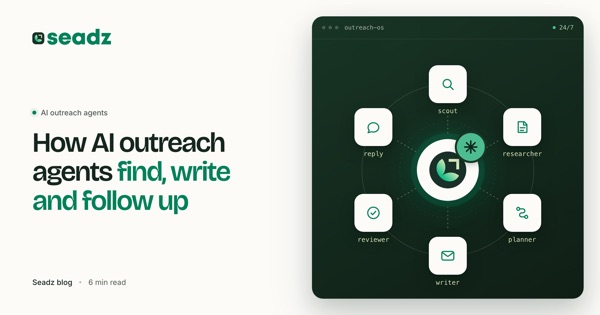
Outreach OS covers the outreach part of the list above. Seadz builds and runs AI outreach agents on email and LinkedIn, and six agents share the work: scout, researcher, planner, writer, reviewer and reply. The scout looks for a signal, such as a growth hire or a funding round. The researcher reads the company, the planner picks the angle and the writer drafts one email per company based on what changed there. The reviewer checks it, and the reply agent handles the answers and the next step.
Your team sets the offer and the call to action. You see the first emails before anything goes out, and you take the call. We keep a suppression list and honour opt-outs. See how it works.
Your next steps
Pick one segment and write down the baseline before anything runs. To talk it through for your market, book a call.