

AI outreach agents are software roles that do the daily work of outbound prospecting. They research companies, write each message, schedule the follow-ups and tag the replies, with a meeting as the aim. A person sets the offer and takes the call.
There are more companies worth contacting than hours to contact them, and outbound can be the first thing dropped when client work is due. AI outreach agents automate the repetitive part, from research to follow-up. A small pilot shows whether that works in your market before you commit your whole list.
What do AI outreach agents do?
An AI outreach agent is software that does one job in the outbound chain. Together they work as a loop: one looks for a company with a reason to be contacted, one reads up on it, one writes the email and one handles the reply. Unlike a fixed sequence, an agent can adapt the message and the next step to what it finds and how the prospect responds.
The jobs usually include:
- Researching a company's site, ads and job posts for a reason to write.
- Drafting one email per company from that research.
- Scheduling follow-ups and stopping them when someone replies.
- Tagging each reply by interest and preparing the next step, ideally a meeting.
The scope is narrow on purpose. Agents do not replace relationship-building or negotiation. For the wider view, read our guide to AI sales agents.
Why AI outreach agents matter
Generic outreach is easy to filter and easy to ignore, and a team busy with client work rarely has time to write better. Agents can make each message more relevant and cut the work of sending it.
Signals can help with timing. A 2026 benchmark roundup from an outbound software vendor covers more than 500 million emails. It reports 8 to 12 percent positive replies for campaigns triggered by a signal such as a job change, funding or a tech install, against 1 to 2 percent for broad list-based campaigns. It is vendor data. Treat it as a direction.
An agent can watch for such signals every day, which is hard to keep up by hand.
What agents change for a busy team
Agents can run daily and schedule follow-ups, so there is less to remember when client work gets busy. Each email starts from something that changed at the company, so it has a reason to be written. Reading sites, ads and job posts is slow by hand, and an agent can do it in the background.
Tags for persona, signal and angle show, through the replies, what to repeat and what to stop. That only works with clean data and someone watching the results. Left alone, a setup drifts: lists go stale and angles wear out.
What to settle before you start
A tool without a process wastes a list quickly. If you run it yourself, settle these first:
- A clear offer, because a weak offer reaches the market faster.
- Who counts as a fit, and what must be true about a company before you write.
- Where contact data comes from, and a clean-up before it goes in.
- Who owns the domains and inboxes, and how much you send.
- Who reads the first emails, answers replies and takes the meetings.
- Cold email rules, which differ per country: check yours before you send.
Plan time for setup and for ongoing management as well.
How to implement AI outreach agents step by step
Follow this order when you run AI outreach agents yourself:
- Write down the offer and the one buyer it is for.
- Choose the signals that mark a good moment to write, such as a new hire.
- Prepare contact data, domains, inboxes and an opt-out list.
- Configure the agents and read the first emails before anything goes out.
- Run a small pilot on one segment and watch replies, bounces and opt-outs.
- Review which signal and angle produced replies, then widen to the next segment.
Skipping the pilot hides which part fails and can damage your domain reputation.
Tool categories to cover and what to ask vendors
Cover these categories before you chase features:
| Category | What it does | What to ask |
|---|---|---|
| Sequencing software | Schedules sends and follow-ups | Does a sequence stop on reply? |
| Data providers | Supply company and contact data | Where does the data come from? |
| CRM | Holds contacts, deals and history | Does it sync both ways? |
| Email infrastructure | Domains, inboxes, sending limits | Who owns the domains? |
| LinkedIn tooling | Connection requests and messages | What are the daily limits? |
| Calendar tools | Book the meeting | Does it show only free slots? |
Ask vendors for references from similar companies and whether your data trains their models. To see how Seadz runs it, read the four steps.
Common mistakes to avoid
Even with good tools, these mistakes are easy to make:
- Writing to a bought list, which adds volume without a reason to write.
- Sending before anyone has read the emails.
- Personalising with a wrong fact, which can cost more than a generic opening.
- Counting opens instead of replies and meetings.
- Changing everything at once, so nobody knows what worked.
- Ignoring bounces and opt-outs.
The cost is damaged sender reputation and wasted effort.
Refinements once the basics run
After the first segment works, a few refinements are worth adding. Trigger campaigns on a change at the company rather than on a static list. Test one variable at a time: the angle, the opening or the call to action. Follow the email with a LinkedIn message to the same person, and hand warm replies to a person the same day. Retire an angle when its replies dry up. All of this takes more setup and monitoring.
How Seadz does it
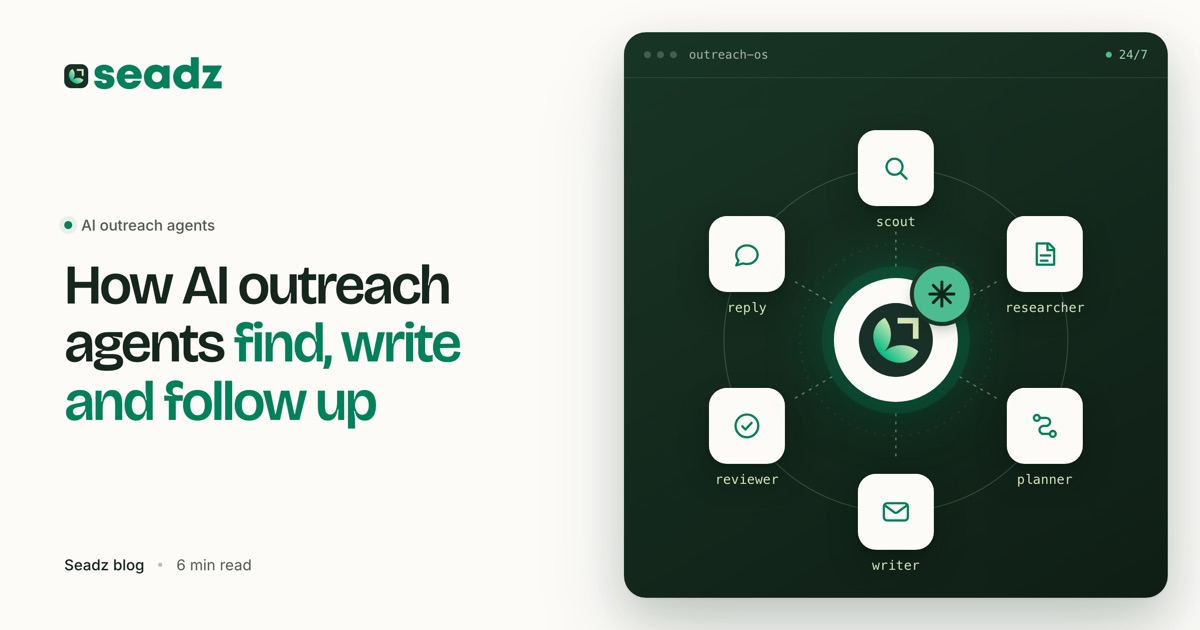
Seadz builds and runs AI outreach agents on email and LinkedIn for agencies and B2B SaaS companies. The system is Outreach OS, with a scout, researcher, planner, writer, reviewer and reply agent.
A scout agent looks for a company with a signal, such as a recurring ad, a growth hire or a funding round. The writer drafts one email per company from what changed there. Your team sets the offer and the call to action. Each email is tagged with persona, signal and angle, so the replies show what to repeat, rethink or stop.
You see the first emails before anything goes out. We keep a suppression list and honour opt-outs. You take the call.
Two clients, not an average. A CRO agency closed a 5.5K deal in week one, from the first outbound campaign. A static ad agency got 25 qualified leads and 6K in new monthly revenue in 30 days. The Outreach OS demo on seadz.io uses a sample company and follows one signal to an example booking.
What to do next
AI outreach agents work when the offer is clear and someone keeps watching the replies. Start with a small pilot of your own, then measure replies and widen.